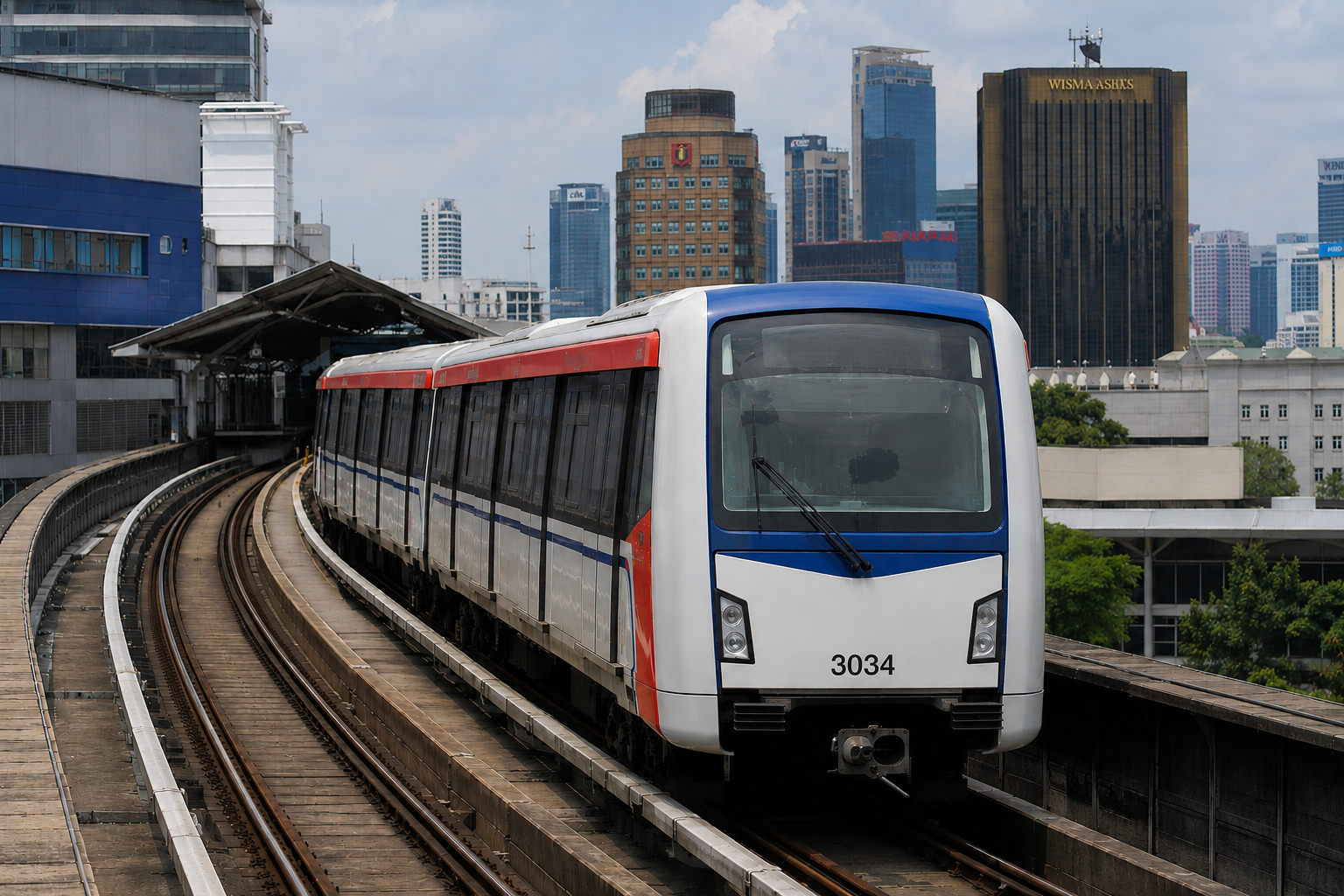
The recent derailment of a Rapid Rail train near Chan Sow Lin, involving 25 passengers who were safely evacuated, should not be treated merely as a short service disruption. It should be seen as a timely warning that Malaysia’s urban rail debate must move beyond affordable fares and emergency response towards a more serious review of maintenance funding, asset condition, and technology-enabled reliability.
Urban rail is now part of the country’s basic economic infrastructure. For many Klang Valley commuters, the LRT, MRT, monorail, and feeder network are a daily means of access to work, education, healthcare, and business activities. The public expects trains to be safe, punctual, affordable, and resilient. Yet every expectation carries a cost, especially as assets age and passenger demand rises.
The Chan Sow Lin case is significant because the derailment occurred near a track switch zone. A switch is a critical part that guides trains from one track to another. Track geometry, point machines, locking mechanisms, signaling interfaces, and train movement authority all need to function in coordination for safe rail operations. The situation also highlights a broader policy issue, as raised in many reports, about whether older rail corridors in places like Malaysia’s Klang Valley are being updated and checked with the necessary technology and investment to meet modern standards.
Malaysia has experienced several urban rail incidents over the years, including the catastrophic collision. These cases differ technically, but they point to the same systemic lesson: rail safety cannot rely only on post-incident investigations. It must be supported by preventive maintenance, asset renewal, real-time monitoring, and a funding structure that protects safety-critical expenditure.
This is where the financial debate becomes unavoidable. Rapid Rail recorded an operating deficit of about RM603 million in 2025, with operating expenditure of about RM1.3 billion and total revenue of about RM721.5 million. Fare revenue formed the main income stream, while non-fare income remained comparatively small. Ticket collection alone is not sufficient to carry the full cost of operating, maintaining, and renewing an urban rail system. This is not unique to Malaysia. Many urban rail systems worldwide require public subsidy, commercial income, and long-term capital funding because farebox revenue rarely covers the full lifecycle cost of rail. Tracks, signaling systems, rolling stock, depots, power supply, control centres, and station equipment require reinvestment. A railway is public infrastructure that reduces congestion, supports productivity, lowers emissions, and improves access to opportunity.
For frequent local users, Malaysia’s fares continue to be among the most reasonable in the area. For B40 households, workers, students, people with disabilities, and senior individuals, affordability is important. Affordable fares must, however, be paired with a practical finance plan. The risk could manifest as postponed maintenance, postponed renewal, a lack of spare parts, a longer recovery following failures, and diminished public trust if the budget gap is not filled.
A modest fare review can help, but it cannot solve the deficit by itself. If fare revenue were around RM695 million, a 10 per cent increase would generate about RM69 million additional revenue, assuming ridership does not decline. That would cover only a small part of an RM603 million deficit. According to a study published in 2021, fare adjustments should be considered as just one part of a wider set of reforms for the Klang Valley rail system, and any changes to fares would be more effective if they are paired with the creation of a dedicated Rail Maintenance and Reliability Fund. If commuters are asked to pay slightly more, they must see that the money is transparently ring-fenced for safety-critical assets such as track switches, signaling systems, train doors, wheels, bogies, braking systems, traction power, depot equipment, platform systems, and emergency readiness. Without transparency, fare increases will be viewed only as an added burden.
For older lines like the Ampang and Sri Petaling corridors, this technology is particularly pertinent. The idea is to acknowledge that aged assets require more sophisticated monitoring, not to say that the entire line is dangerous. While periodic inspection is still crucial, risk-based maintenance planning, integrated asset management, and real-time data should support it.
The cost should be treated as a planning estimate rather than an official figure. A practical pilot for high-risk locations such as Chan Sow Lin, depot access areas, major turnouts could cost about RM10 million to RM30 million. This would cover switch monitoring, selected track monitoring, wayside sensors, asset health dashboards, training, integration and cybersecurity controls. A more substantial upgrade for one legacy line, such as the Ampang/Sri Petaling corridor, could be estimated at RM50 million to RM120 million. This may include wider turnout monitoring, ultrasonic or LiDAR inspection, wheel impact and hot axle box detection, maintenance system integration, dashboard, data platform and training. A full network-wide predictive maintenance programme for Rapid Rail, covering LRT, MRT, monorail, depots, stations, control centres, and rolling stock, may require about RM250 million to RM500 million over several years. The amount sounds substantial, but it must be compared with the disruption cost, emergency repairs, replacement buses, lost revenue, productivity loss, and public distrust.
International practice shows that a stronger business model must support technology. Singapore has strengthened rail reliability through condition monitoring and predictive maintenance. The United Kingdom’s Network Rail uses artificial intelligence to predict defects and prioritise maintenance. Hong Kong’s MTR and Japanese rail operators offer lessons in technology, discipline, commercial income, and lifecycle asset management.
Malaysia can adapt these lessons through station commercialisation, naming rights, advertising, transit-oriented development, corporate mobility packages, and stronger non-fare revenue. Major stations should not be treated merely as boarding platforms, but as economic nodes that generate commercial value. This will not replace government support, but it can reduce pressure on fares and help fund maintenance.
The most important reform is accountability. Any maintenance and reliability fund must be tied to indicators such as train availability, preventive maintenance completion, switch failure rates, passenger delay minutes, response time, asset health score, and renewal backlog. Public trust grows when commuters see measurable improvements, not only announcements.
The Chan Sow Lin event should be viewed as a policy opportunity. It should prompt not only a technical probe, but also a more comprehensive examination of how Malaysia funds, monitors, and renews safety-critical urban rail assets. The public expects inexpensive fares, but they must be at the expense of dependability. Emergency repairs are insufficient to maintain a modern railway. Predictive maintenance, ring-fenced renewal funds, and a diverse business model are now all part of the actual cost of a dependable railway.

Associate Professor Dr. Nor Aziati Abdul Hamid
Head, Industry Centre of Excellence for Railway
Institute of Integrated Engineers
Universiti Tun Hussein Onn Malaysia