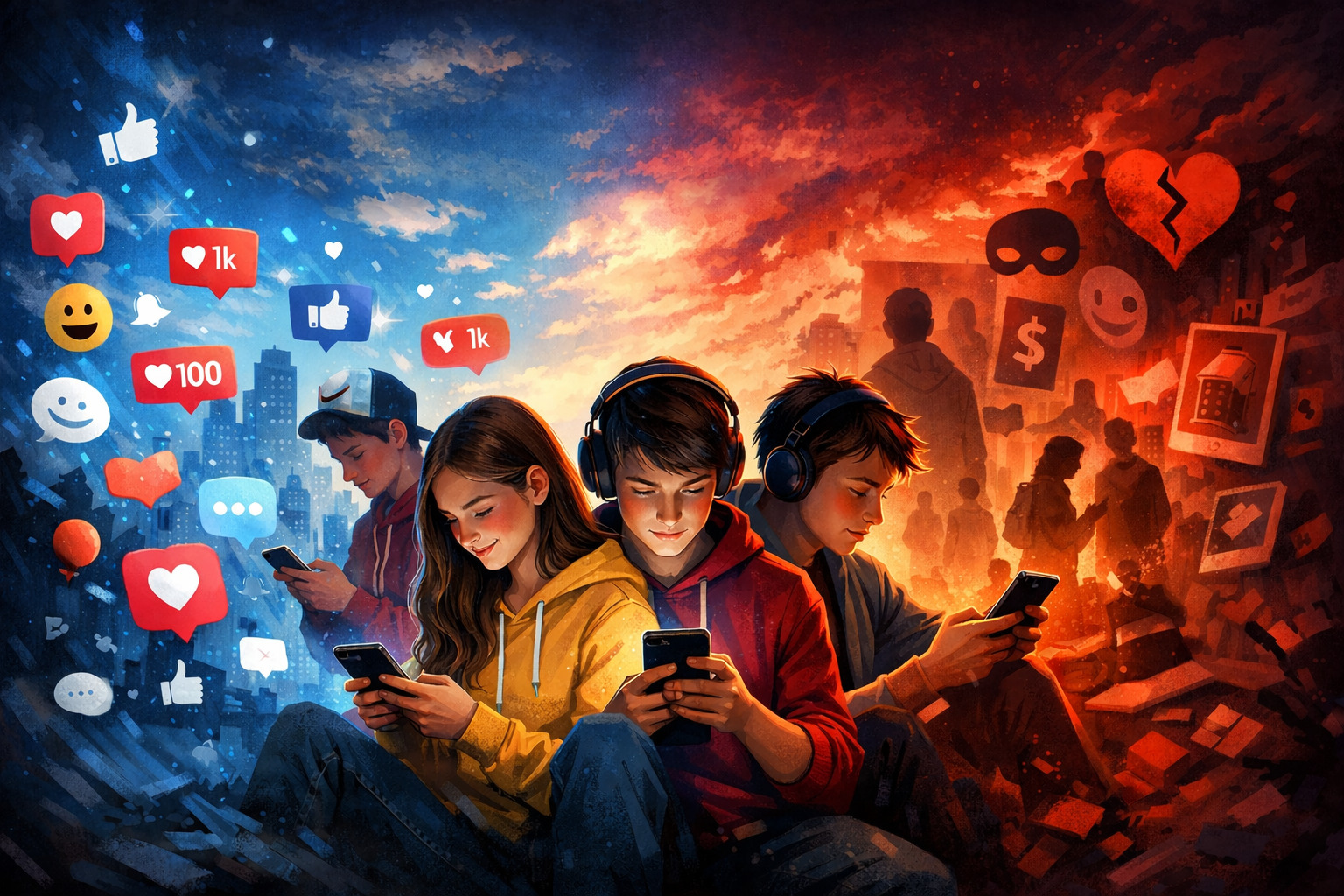
In today’s digital age, social media has become deeply embedded in everyday life. It shapes how people communicate, learn, work, and even dream about their future. For adults, adapting to digital norms may be a conscious choice, but for teenagers, social media is often an unavoidable environment that strongly influences their beliefs, aspirations, and sense of self. While social media platforms offer opportunities for creativity and connection, the uncritical consumption of influencer content raises important concerns about the values being normalised among young people.
Increasingly, young people aspire not to traditional professions such as teachers, engineers, or doctors, but to becoming YouTubers, TikTokers, or social media influencers. The appeal is understandable: influencers are often portrayed as wealthy, popular, and admired, with millions of followers and access to glamorous lifestyles. Popularity becomes priority, and visibility is equated with superiority. Whether this is harmful, however, depends largely on the values and messages promoted by the influencers they choose to follow.
Globally, concerns about the unchecked influence of online personalities are growing. In China, for example, regulations have recently been tightened to require influencers who discuss professional or specialised subjects to possess relevant qualifications. This move aims to protect audiences from misleading or unfounded advice, acknowledging that not all influencers are credible or responsible. Such measures highlight a broader issue: the sheer volume of online content, much of which subtly promotes questionable beliefs that young audiences may absorb without critical evaluation.
Three particularly troubling ideas appear repeatedly in the content of some irresponsible social media influencers, each with the potential to shape young minds in harmful ways.
First, success is often reduced to the number of likes, views, followers, and material possessions. While it is inspiring to see figures such as Khairul Aming, Muhammad Sofian Abdullah (Sofyank), and Dr. Malar Santhi use social media to share knowledge, skills, and professional expertise, not all influencers promote such constructive messages. Some openly claim that failing major examinations such as the Sijil Pelajaran Malaysia (SPM) is inconsequential, arguing that online fame alone guarantees success. Academic qualifications are dismissed as irrelevant, as long as one can display luxury cars, branded goods, and a lavish lifestyle on screen. This narrative simplifies success into material wealth and online validation, ignoring the intellectual, moral, and societal dimensions that make success meaningful.
This belief needs to be challenged. Even prominent content creators themselves have emphasised that sustaining a career in the digital industry requires more than popularity. Critical thinking, knowledge, professionalism, and ethical conduct are essential to remaining relevant and credible. Education, therefore, should not be portrayed as optional or inferior, but as a foundation that supports both personal growth and national development.
Second, social media increasingly promotes the idea that self-worth is determined by physical beauty. Constant exposure to idealised and heavily curated images causes many young people to compare themselves unfavourably with others, leading to anxiety, low self-esteem, and a distorted self-image. This problem is compounded by the aggressive marketing of beauty products, often endorsed by influencers who are financially compensated to promote unrealistic standards. Many followers are unaware that these appearances are achieved through filters, expensive treatments, or cosmetic procedures. When such standards become normalised, young people may feel pressured to abandon their authenticity in pursuit of unattainable ideals.
A healthier perspective is hence urgently needed. Self-worth should not be confined to physical appearance, but grounded in talents, abilities, character, and contribution to society. Without this shift, social media risks cultivating a generation that measures value through comparison rather than self-acceptance.
Third, online engagement is frequently prioritised over truth and real social issues. Sensitive cases involving bullying, abuse, or injustice are sometimes exploited for attention, with rumours and speculation spreading faster than verified information. It should be noted that unverified narratives can interfere with investigations and mislead the public. In such an environment, critical thinking is often sidelined in favour of sensationalism. If this trend continues, young people may grow accustomed to accepting misinformation without question, eroding trust and weakening their ability to make informed judgments.
These concerns point to a larger responsibility shared by influencers, educators, parents, and society at large. Being a social media influencer is not merely about visibility or entertainment; it carries moral and social accountability, particularly when the audience includes impressionable teenagers. At the same time, young users must be guided to engage with online content thoughtfully and critically, rather than passively absorbing whatever appears on their screens.
In conclusion, social media is a powerful tool that can either enrich or undermine the values of future generations. Without guidance and reflection, young people may be influenced by shallow notions of success, unrealistic beauty standards, and careless attitudes toward truth. Promoting responsible social media use and reasoned judgment is therefore not optional, but essential. For a better and more ethical digital culture, we must look beyond likes and views, and re-centre values that nurture integrity, critical thinking, and genuine human development.

Nurul Izzyana Rahmat
Language Teacher
Centre For Language Studies
Universiti Tun Hussein Onn Malaysia (UTHM)