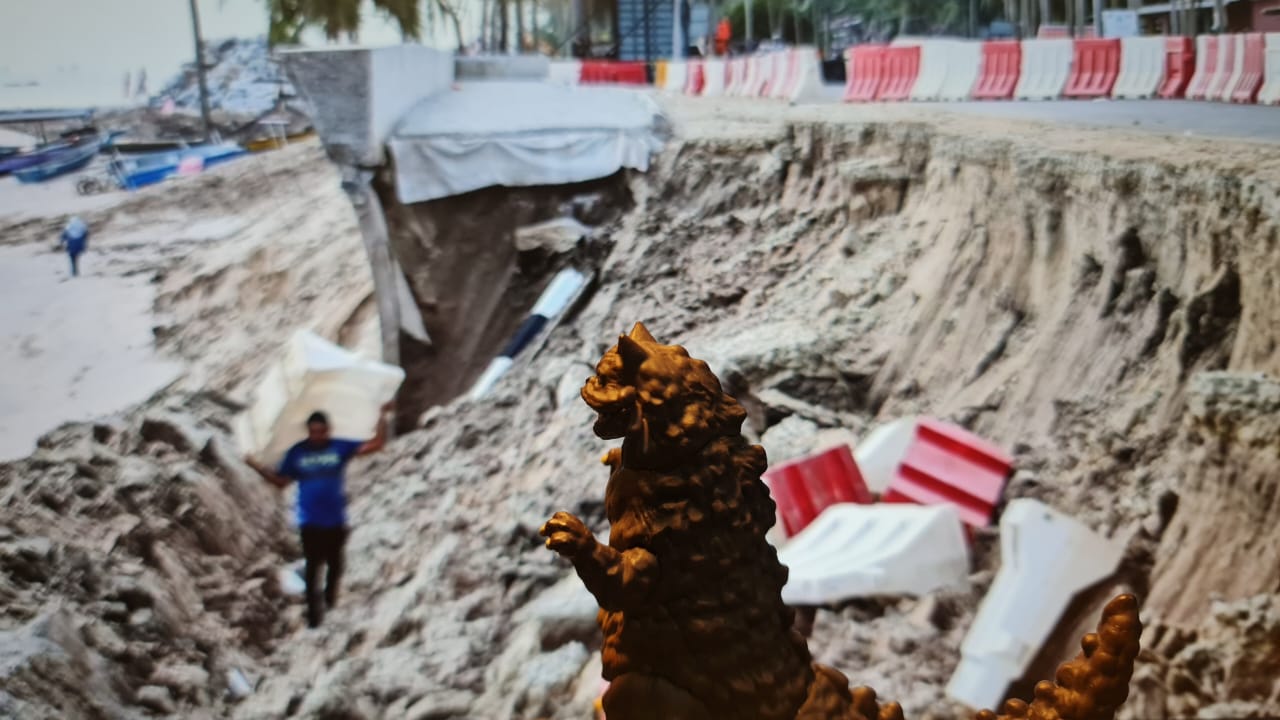
It was recently reported that in late September 2025, a newly completed coastal embankment along Route T145 in Kuala Nerus, Terengganu collapsed during the Northeast Monsoon, less than a month after its RM 4.95 million construction was completed. While the surface damage was immediately visible, the underlying causes of failure lay within the embankment’s geotechnical system, specifically the interaction between soil behaviour, groundwater pressure and foundation design.
The hidden problem beneath the surface
Coastal embankments rarely fail simply because waves strike the road surface. The true vulnerability lies in how water moves through the soil supporting the structure. In Kuala Nerus, repeated wave action at the base of the embankment triggered a process called “piping” where fine sand particles were slowly washed out from the foundation.
Each incoming wave forced water into the embankment, while each retreating wave drew it back toward the sea. This created strong hydraulic gradients within the soil, gradually carrying away fine particles and hollowing out the supporting ground. Over time, a “suction” effect developed at the toe of the embankment. Trapped water was pulled seaward faster than it could drain, increasing internal pore-water pressures and forming hidden voids.
Once sufficient soil was lost, the embankment rotated and collapsed under its own weight, which is a classic rotational geotechnical failure. Importantly, such failures often occur suddenly, with little surface warning, explaining why a newly completed structure could fail so quickly.
Why surface rock armour was not enough
From the outside, the embankment appeared protected with conventional rock armour. Traditional revetments assume that surface protection alone is sufficient and that the underlying soil stays stable. However, along high-energy coastlines such as Terengganu’s, this assumption is often invalid.
Rock armour can absorb direct wave impact but does little to prevent erosion below the surface. When foundation protection does not extend beneath the largest scour depth, waves and currents can undermine the embankment from below, regardless of how large or heavy the surface stones are.
This is why modern coastal engineering emphasises deep-toe stabilisation. Steel sheet piles or micropiles driven deep into the seabed form a subsurface barrier, blocking soil loss and anchoring the embankment to stable ground.
How a small failure triggered a sudden collapse
Once the embankment toe lost support, the outer rocks shifted slightly, triggering a progressive “zipper effect.” The displacement of a few stones reduced support for neighbouring rocks, causing the revetment to unravel. At the same time, heavy monsoon rainfall allowed water to infiltrate faster than it could drain. Trapped water increased pore-water pressures, reducing soil shear strength and accelerating collapse.
The combination of undermined foundations, wave loading, and trapped water pressure caused the embankment to fail suddenly, despite appearing sound on the surface.
Why water must be allowed to escape
Overtopping waves and heavy rainfall force water into the embankment body, not just on the surface. If this water cannot escape, internal pressure builds up, pushing outward and weakening the soil structure. From a geotechnical perspective, elevated pore-water pressures reduce shear strength, making slopes more prone to sliding or rotation.
Modern embankments address this by incorporating sub-surface drainage systems, such as perforated pipes and deep weep holes. These allow trapped water to escape quickly, enabling the embankment to “breathe” and significantly reducing the risk of sudden failure during extreme weather events.
Better materials, better outcomes
Once the problem of trapped water is understood, engineering solutions become clearer. Coastal engineers now favour interlocking armour systems rather than loose rocks. For instance, Articulated Concrete Blocks (ACBs) form a continuous mat that can flex and settle with minor ground movement without breaking apart, keeping protection even when the foundation shifts.
Beneath these blocks, geotextile filter layers allow water to pass while holding fine soil particles in place, preventing internal erosion. During the intense rainfall of December 2025, such filters would have reduced pore-water pressures and preserved the embankment’s internal strength.
Together, advanced drainage and resilient armour systems could effectively transform embankments from rigid, vulnerable barriers into adaptive, long-lasting structures capable of withstanding extreme coastal events.
So, what can be learned?
The Kuala Nerus failure shows that coastal protection cannot rely on surface armour alone. Soil behaviour, water pressures and foundation stability are equally critical. Integrating deep-toe stabilisation, interlocking armour, geotextiles and sub-surface drainage ensures embankments can withstand monsoons and extreme waves while supporting sustainable development and protecting public safety. These measures also demonstrate how engineered, geotechnically informed solutions address both visible forces and hidden subsurface processes, creating resilient coastal infrastructure for the nation.

Prof. Ir. Dr. Chan Chee Ming
Faculty of Engineering Technology
Principal Researcher
Research Centre for Soft Soils (RECESS)
Universiti Tun Hussein Onn Malaysia