
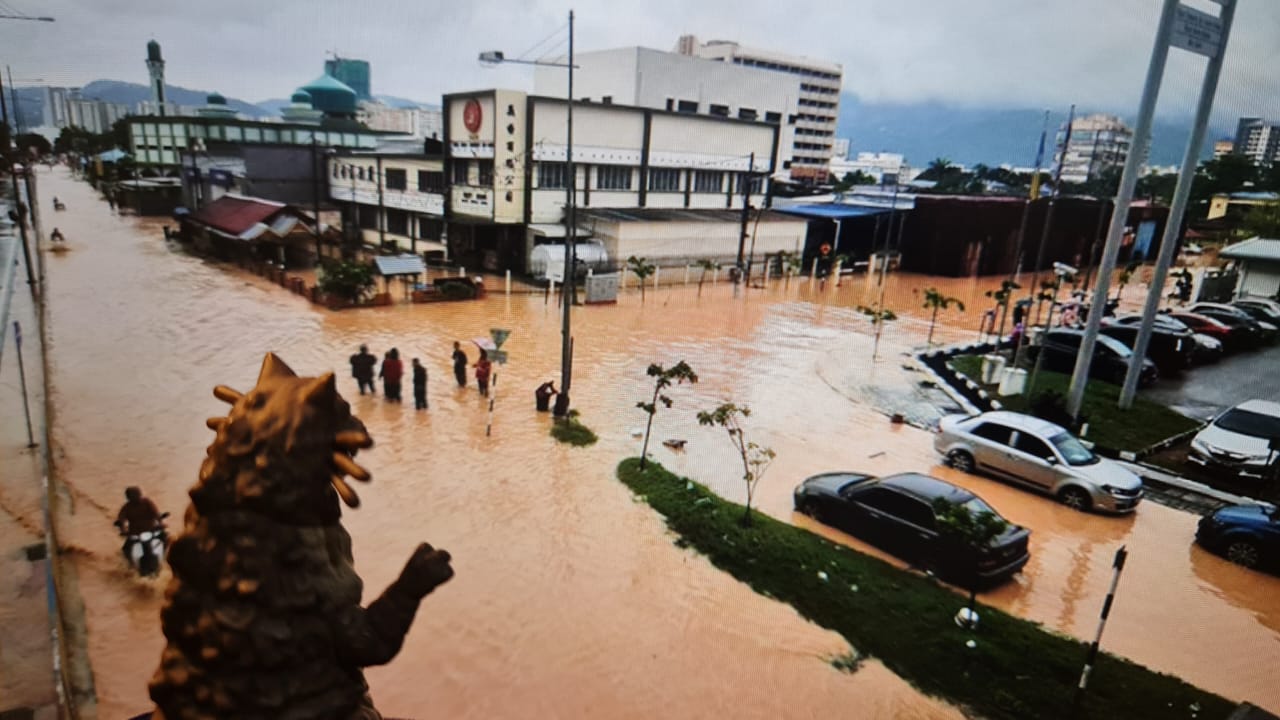
Strengthening Malaysia’s disaster early warning system with improved forecasting accuracy and operational efficiency has been made a top priority by Natural Resources and Environmental Sustainability Minister Datuk Seri Arthur Joseph Kurup amid prolonged Northeast Monsoon conditions nationwide, including Sabah.
In recent development, Malaysia faces a critical period of natural disaster risk from late 2025 to early 2026, driven by the Northeast Monsoon (November–March) and a brief, weak La Niña. Forecasts indicate above-average, persistent rainfall, with December 2025 and January 2026 expected as peak months. The combined effects may bring prolonged rainfall, repeated monsoon surges and increased risks of flooding, flash floods, coastal erosion and other water-related hazards. High-risk areas include Kelantan, Terengganu, Pahang, Johor, Sabah and Sarawak. Rising water levels and saturated soils threaten both communities and infrastructure, highlighting the need for careful geotechnical planning and preparedness.
Geotechnical risks on the rise
Heavy and continuous rainfall affects both soils and infrastructure. Rising water tables saturate soils, reducing their ability to absorb more precipitation. Saturated ground increases surface runoff, which can overwhelm urban drainage, trigger flash floods and accelerate erosion along rivers and coasts. In addition, rapid water flow can remove topsoil, undercut embankments and destabilise riverbanks, creating sedimentation and structural hazards. While slope failures in hilly areas are usually localized, triggered by erosion, infiltration or land-use changes, embankments, reclamation layers, and infrastructure on soft marine and organic soils face systemic risks over large areas, making geotechnical stability a key concern.
Soils turned vulnerable
Malaysia’s low-lying and coastal regions are typically underlain by soft marine and organic soils, which are highly compressible, retain high moisture content and have low shear strength. These soils are naturally weak and slow to consolidate, meaning they cannot quickly adjust to additional loads or prolonged saturation. Embankments constructed on these soils, including riverbanks, reclaimed land and transport routes, are particularly vulnerable. Prolonged saturation during heavy rainfall increases pore-water pressure within the soil, reducing effective stress and the soil’s load-bearing capacity. When effective stress drops, the soil skeleton can deform, causing lateral spreading, surface cracking, differential settlement and in extreme cases, structural failure of embankments. Such failures can clearly disrupt transportation networks, compromise reclaimed land, and even endanger lives if riverbanks or flood defences collapse.
Intensified risks in organic soils
Organic-rich soils present additional challenges. Their high-water content and compressibility mean that repeated wetting and drying cycles, as often occurs during prolonged monsoon rains, can weaken soil structure over time. These soils tend to consolidate very slowly, meaning that even after heavy rains subside, the ground may remain soft and susceptible to settlement or lateral movement. Infrastructure such as roads, bridges and embankments constructed on these deposits is particularly sensitive to differential settlement. Uneven settlement can cause tilting, cracking or even structural instability, particularly if drainage and stabilization measures are insufficient. Unlike steep slopes, where landslides may occur due to superficial erosion, the failure of embankments over soft soils is primarily a response to hydraulic loading, low shear strength and excessive compressibility, factors that require engineering solutions rather than purely ‘superficial’ vegetative or drainage interventions.
Endangered by hydraulic forces
Hydrological stresses during the monsoon further amplify these geotechnical risks. Flash floods can temporarily inundate embankments and low-lying areas, increasing lateral pressure on riverbanks and drainage structures. Storm surges along the east coast can combine with high tides to impose additional hydrostatic and hydrodynamic forces on coastal embankments, which may already be weakened by saturated soils. Infrastructure such as water supply pipelines, pumping stations and drainage networks can be compromised by such flooding, compounding the socio-economic impact of heavy rainfall events. Of particular concern, the interaction between saturated soft soils and hydraulic forces can lead to secondary geotechnical hazards, such as soil liquefaction, lateral spreading or foundation settlement, which persist even after the rains have stopped.
Geotechnical solutions to the rescue
Mitigating these risks requires a combination of engineering, monitoring and preparedness measures. Geotechnical engineers often employ soil stabilization techniques to improve the mechanical properties of soft marine and organic soils. Cement or polymer-modified binders can increase soil stiffness, reduce compressibility and accelerate consolidation, allowing embankments and reclamation layers to better withstand prolonged saturation and heavy loads. Preloading and staged embankment construction are additional strategies, allowing the soil to gradually adjust to new loads and minimize differential settlement and lateral spreading. Properly designed surface and subsurface drainage systems are critical for controlling pore-water pressures and preventing prolonged saturation, which is the main trigger of embankment instability.
Preparedness for effective mitigation
Monitoring and early warning systems are equally important. Continuous observation of rainfall intensity, river levels, soil moisture and groundwater tables allows authorities to anticipate emerging risks and take timely action. Routine maintenance of embankments, riverbanks and coastal protection structures ensures that vulnerabilities do not compound during heavy rainfall events. Residents in low-lying or high-risk areas should secure important belongings, clear drains and adhere strictly to official warnings issued by MetMalaysia or local authorities. By combining technical interventions, continuous monitoring and public preparedness, Malaysia can reduce the impact of monsoon-driven flooding, embankment failures and associated infrastructure damage.
As a conclusion through geotechnical solutions, vigilant monitoring and proactive preparedness, Malaysia can turn monsoon and climate risks into manageable challenges, building long-term resilience against increasingly extreme weather.

Prof. Ir. Dr. Chan Chee Ming
Faculty of Engineering Technology
Principal Researcher
Research Centre for Soft Soils (RECESS)
Universiti Tun Hussein Onn Malaysia