

In an incident just happened last month in Cybersouth, has underscored the critical importance of excavation site safety when a landslide claimed the life of a foreign worker and injured others during utility-related construction works. Emergency responders arrived within minutes, but one of the workers, buried beneath the collapsed soil, was pronounced dead at the scene, while his colleague sustained serious injuries.
This tragedy highlights the persistent risks associated with excavation activities and the need for stricter safety measures, better hazard monitoring and improved protection protocols to prevent such avoidable fatalities.
Excavation and hazards
Excavation work, whether for trenches, tunnels, repairs or foundation preparation, is a common but high-risk activity in construction. It involves removing soil or rock, often in areas where ground conditions can shift unexpectedly or where underground utilities such as water pipes, gas lines or electrical cables may be hidden. Understanding the type of soil being excavated and providing proper support are essential steps to prevent collapses. While newer trenchless technologies can reduce the need for open digging, many projects still require careful excavation planning to keep workers and the public safe.
Hazard mitigation and communication
Successful excavation safety relies on thorough preparation and clear, continuous communication among all stakeholders. Clients contribute by funding comprehensive site investigations and supporting further assessments if ground conditions differ from expectations. Supervisors must remain vigilant to changing soil behaviour and adjust work methods through structured risk assessments.
Equally critical is coordination between contractors, utility providers and building occupants: all underground installations must be accurately located and, where necessary, isolated, particularly near occupied buildings. Also, maintaining open communication with neighbours ensures safe access and minimises disruption. This collaborative, well-coordinated approach creates a safer, more controlled excavation environment for everyone involved.
Soil-to-man communication: Safety assessment
A comprehensive site investigation is essential before any excavation work begins, providing the foundation for safe and informed planning by the excavation supervisor and main contractor. This includes identifying all underground utilities, i.e. gas, water, sewerage, electricity, telecommunications and any chemical or fuel lines, alongside assessing the site’s history, nearby buildings and planned structures.
Soil characteristics, potential contamination, watercourses, groundwater levels and soil type must be evaluated to guide excavation methods too. Plans should cover material storage, haul routes, workspace, temporary support, workforce size, local weather and expected excavation duration, with robust emergency arrangements in place to manage unforeseen risks.
Assessment and controls
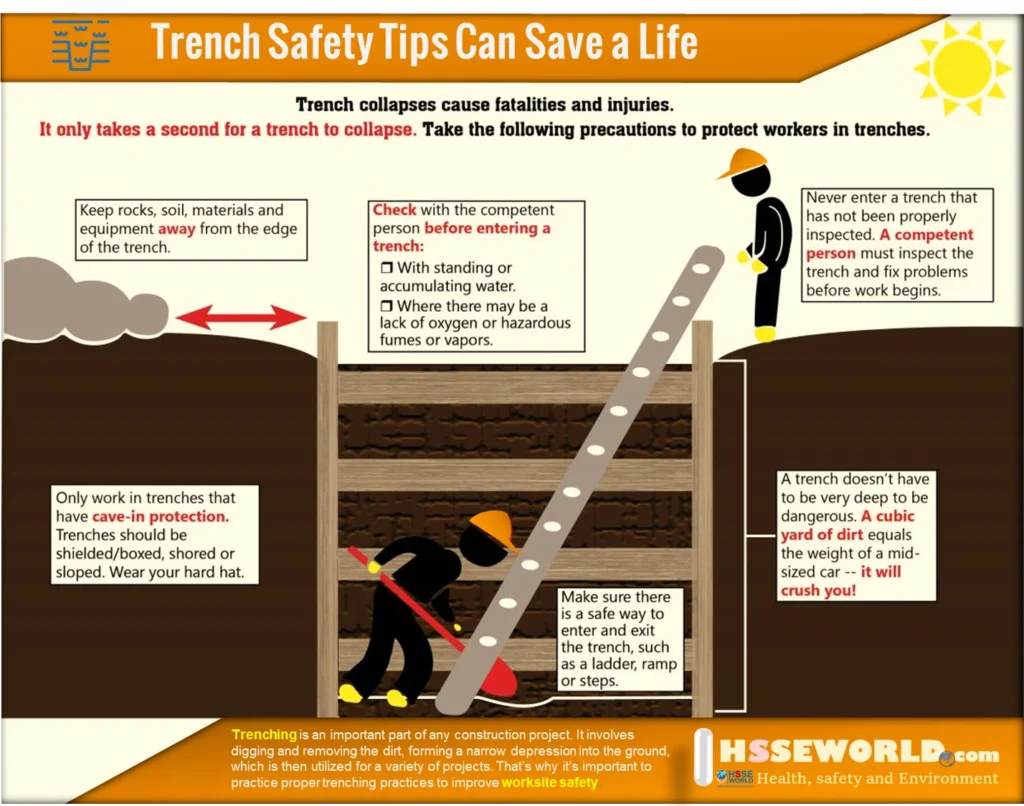
Workers should never enter an excavation unless proper safety measures, such as shoring, sheet piling or other supports, are in place. These supports are designed based on soil and rock conditions determined through thorough site investigations and testing.
If supports are not used, excavation walls must be cut at a safe angle so that the soil can remain stable under normal working and weather conditions. For shallow, stable trenches, vertical walls up to 1.5 m may be acceptable, but deeper trenches always require additional precautions. Another method to secure excavation walls is benching or stepping, where the sides are cut into horizontal levels that are wide enough and not too tall, following standard guidelines.
Trenches deeper than 3 meters must be benched or stepped to prevent collapse. Since soil conditions can change, particularly during wet seasons such as the monsoon, excavation walls require regular inspections, and rock faces may need scaling to remove loose material.
Hazards control with support systems
Excavation safety relies on temporary ground supports to prevent trench or pit walls from collapsing. These can include timber boards reinforced with horizontal wales and struts, or steel sheet piling with timber or steel braces. “Sheeting” refers to boards or steel sheets used to hold back soil: When close together, it is close sheeting for extra strength; when spaced apart in stable clay, it is open sheeting. Horizontal planks, called wales, reinforce the sheeting and must be properly braced at each end, with all shoring resting on a stable base to prevent shifting.
Temporary supports must remain until permanent structures, like retaining walls, have fully gained strength. Overhanging soil or undercut banks also require shoring, and proprietary systems, e.g. trench boxes, manhole shores or hydraulic frames, must follow manufacturer instructions. Besides, excavations near buildings may need additional measures, such as underpinning or bracing, especially when foundations are less than twice the excavation depth from the edge. Finally, backfilling should be done in layers, filling all voids, including those left by temporary supports, which must not be removed prematurely. Adequate precautions must also prevent workers, equipment or materials from falling into the excavation, ensuring a safe site.
Systemic precautions to ensure excavation safety
As Malaysia advances toward sustainable construction and stronger worker protection frameworks in line with the Sustainable Development Goals (SDG 2015–2030), rigorous hazard prevention, meticulous excavation safety planning and green construction practices become increasingly vital. Ensuring the safety of excavation sites today paves the way for a future where infrastructure development progresses hand-in-hand with social responsibility, environmental stewardship, and unwavering respect for every worker’s life.

Prof. Ir. Dr. Chan Chee Ming
Faculty of Engineering Technology
Principal Researcher
Research Centre for Soft Soils (RECESS)
Universiti Tun Hussein Onn Malaysia