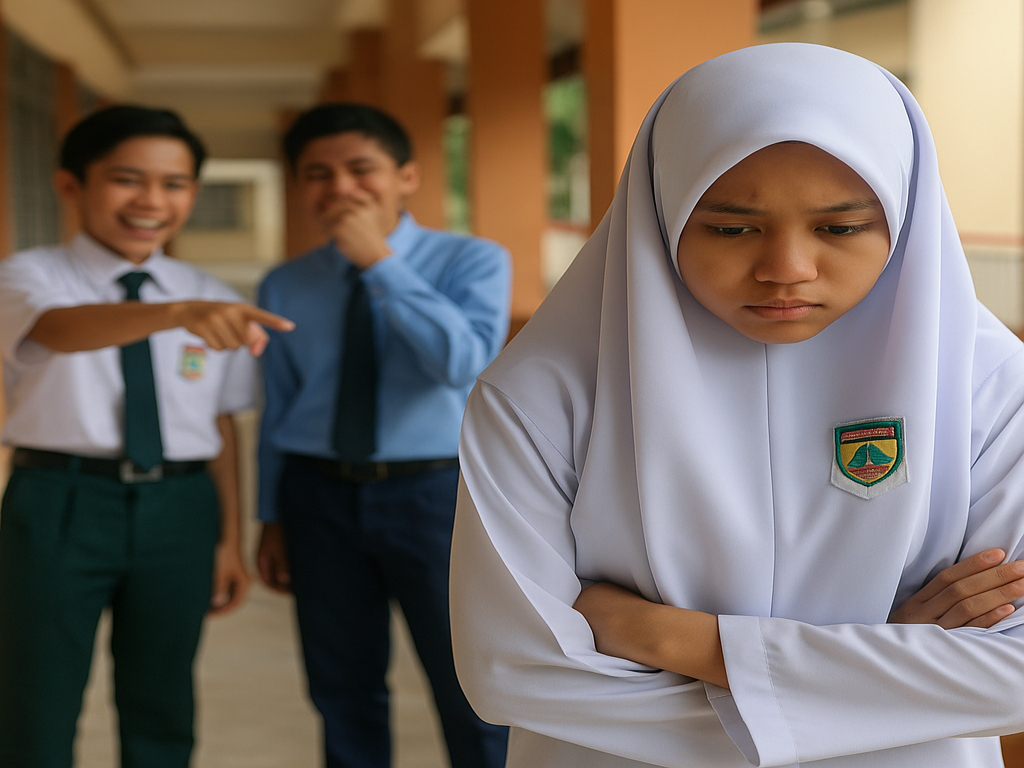
It begins quietly, a snide comment in the classroom, a shove in the corridor, a humiliating post shared on social media. For the victim, it is more than “just a joke”. For the rest of us, it is a mirror reflecting the cracks in our education and social systems. Bullying in Malaysian schools has moved far beyond harmless teasing. It is now a serious, escalating problem that leaves emotional scars as deep as physical wounds. Teachers report students coming to class withdrawn, anxious, or suddenly refusing to attend school at all. For some, the fear is so great that even walking through the school gate becomes an ordeal.
The numbers are a wake-up call. The Ministry of Education recorded 3,883 bullying cases in 2022, rising to 4,994 in 2023. By October 2024, the Students Discipline System (SSDM) had already logged 6,208 cases, despite nationwide campaigns and stricter disciplinary procedures. Clearly, the question is not whether we are aware of the problem, but whether we are addressing its roots effectively. The figures represent real children, each with a story. Behind every statistic is a name, a family, and a network of friends affected by the behaviour of one or more peers.
Why is this happening?
- Gaps in emotional education
While many point to poor discipline or insufficient supervision, the absence of emotional education in our curriculum is an equally critical gap. Academic performance takes centre stage, leaving little time to develop empathy, resilience, and emotional intelligence; skills proven to reduce aggressive behaviour. Imagine if lessons on kindness, conflict resolution, and mental well-being were embedded into daily classroom activities. In countries where social-emotional learning is prioritised, bullying rates have shown measurable declines. Yet in Malaysia, these aspects remain secondary, often addressed only after an incident occurs.
- Home environment matters
Children learn from what they see. A household filled with aggression, shouting, or cold neglect often becomes a breeding ground for similar behaviours outside the home. Parenting styles at both extremes, excessive pressure or total lack of boundaries, can leave children unequipped to manage conflict or build healthy relationships. A child who grows up hearing insults may normalise hurtful speech; one who is rarely corrected may struggle to respect limits. Healthy boundaries, consistent communication, and parental involvement in school life can act as powerful deterrents to bullying.
- Social support gaps
The Malaysian Youth Mental Health Index 2023 (MyMHI’23), based on responses from nearly 6,000 youths nationwide, rated overall youth mental health at 71.9, a score that falls within the moderate risk category. While this may not appear alarming at first glance, a closer look reveals deeper concerns. The weakest areas were the Surrounding Environment (65.5), Social Support (68.3), and Healthy Mind (66.1) domains. These scores point to physical and social environments that feel unsafe, inadequate emotional and practical support from family, friends, or professionals, and a growing prevalence of anxiety and depression among young people.
The intention of highlighting these figures is to show that bullying does not occur in a vacuum; it thrives in environments where young people already feel unsafe, unsupported, or emotionally fragile. A school can have rules against bullying, but if students walk into an environment where they feel judged, excluded, or overlooked, those rules have little effect. Similarly, a child who lacks reliable support networks is more likely to feel powerless when targeted, or conversely, may resort to bullying to assert control and mask personal insecurities.
These statistics serve as more than just numbers; they are warning signs that the conditions in which our youths are growing up, at home, in school, and in the wider community are not conducive to emotional safety. Addressing bullying effectively, therefore, requires us to address these mental health gaps, ensuring that every young person feels valued, supported, and safe enough to both resist bullying and refuse to participate in it.
Where do we start?
In schools – Teachers and administrators must be given the tools and time to teach emotional skills alongside academic content. Peer support programmes, restorative justice approaches, and safe reporting channels should be normalised, not treated as optional add-ons. Successful anti-bullying strategies in other countries show that when students are empowered to stand up for each other, bullying incidents drop significantly. Regular training for teachers on recognising early warning signs can also prevent escalation before harm becomes severe.
At home – Parents need to model respectful behaviour, maintain open communication, and balance discipline with warmth. Regular check-ins with children about their school life can catch issues before they escalate. Simple questions such as ‘Who did you sit with at lunch today?’ or ‘How was your group project meeting?’ can open doors to deeper conversations. Parents should also work with schools to ensure consistent messages about acceptable behaviour.
In the community – NGOs, religious groups, and local councils can run awareness campaigns, support groups, and youth activities that encourage empathy and mutual respect. Sports, arts, and volunteer programmes can provide safe spaces for young people to interact positively, reducing the likelihood of conflict. Communities can also establish anonymous reporting systems for bullying incidents, making it easier for victims and bystanders to seek help without fear of retaliation.
In policy – Authorities should publish detailed MyMHI data broken down by social class, geography, ethnicity, and gender. This would allow for targeted interventions, ensuring no group of youths slips through the cracks. Policy should also include clear accountability for schools to implement anti-bullying measures and provide annual public reports on progress. Without transparency and follow-up, even the best strategies risk becoming paperwork exercises rather than meaningful change.
The bigger picture
Bullying is not merely a school problem; it is a societal indicator. No child is born a bully. They become one through the lessons — spoken and unspoken — that they absorb from their surroundings. If we want safer schools, we must work on building kinder homes, stronger communities, and an education system that values character as much as grades. This requires sustained commitment from all layers of society, not just when a high-profile case hits the headlines. Our collective response should not end with punishment, but extend to rehabilitation, empathy-building, and long-term prevention.
The path forward demands more than slogans. It requires that we teach, model, and reward the behaviours we want to see in the next generation. Because the real question is not “Where did we go wrong?” but “When will we start getting it right?”. If we do not act now, we risk raising a generation that sees cruelty as strength and kindness as weakness — a future none of us should be willing to accept.

Affah Mohd Apandi
Language Teacher
Department of English Language and Linguistics
Centre for Language Studies
Universiti Tun Hussein Onn Malaysia